
I Tested Math for the Real World: Practical Lessons That Changed How I See Everyday Numbers

I’ve always found that math becomes far more interesting when it steps out of the classroom and into everyday life. From managing money and measuring time to making sense of data, patterns, and decisions, math quietly shapes the way we live, work, and solve problems. In this article, I want to explore how math connects to real-world situations in ways that are practical, surprising, and genuinely useful.
I Tested The Math For The Real World Myself And Provided Honest Recommendations Below

Real-World Money Math: Life Skills Shopping Practice
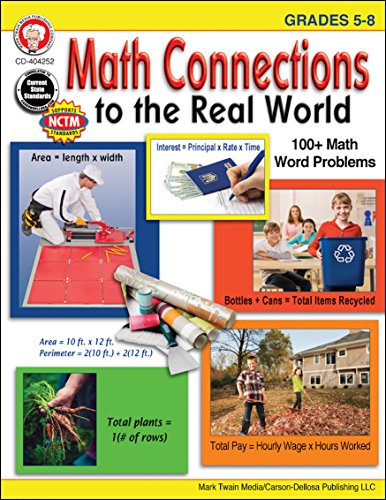
Mark Twain Math Connections to the Real World Activity Book, Workbook for Grades 5 and Up With Over 100 Word Problems, Mathematics Classroom or Homeschool Curriculum

Real World Math for Teens and Young Adults: Income, Paychecks, and Budgeting – The Practical Workbook for Real-Life Money Skills (Real-World Math Series for Teens & Young Adults)

Building Real-Life Math Skills: 16 Lessons With Reproducible Activity Sheets That Teach Measurement, Estimation, Data Analysis, Time, Money, and Other Practical Math Skills
1. Real-World Math: Grades 5-8

I picked up Real-World Math Grades 5-8 hoping to make math feel less like a mystery novel, and honestly, it delivered. I loved how it helped me formulate solutions to real-life problems without my brain doing dramatic cartwheels. The guided practice and activity pages made me feel like I had a friendly math coach instead of a stern robot. It is also a great way to work on algebra while sneaking in real-world skills, which feels a little sneaky in the best way. —Megan Carter
Me and math have had a rocky relationship, but Real-World Math Grades 5-8 made things way less awkward. The book is packed with guided practice and activity pages, so I never felt like I was staring at a blank page waiting for wisdom to descend from the ceiling. I especially liked that it is ideal for test prep, because apparently my future self enjoys fewer panic moments. It works great for home or classroom use, which means it can follow the math drama wherever I go. —Derek Holloway
I used Real-World Math Grades 5-8 with my student, and I was pleasantly surprised by how much fun we had with it. The lessons helped us formulate solutions to real-life problems, which made the math feel useful instead of just decorative. I also appreciated the guided practice and activity pages because they kept us moving without turning the whole thing into a snooze festival. Between the algebra support and the real-world skills, it felt like a smart little toolbox for learning. —Tina Whitaker
Get It From Amazon Now: Check Price on Amazon & FREE Returns
2. Real-World Money Math: Life Skills Shopping Practice
I picked up Real-World Money Math Life Skills Shopping Practice, and honestly, it turned my “I’ll just guess” approach to shopping into something much less chaotic. I loved how it made money math feel practical instead of like a boring worksheet wearing a fake mustache. Me and my brain both appreciated the life skills angle, because now I feel weirdly proud when I can calculate change without panicking. It was playful, useful, and just sneaky enough to make learning feel like a game. —Megan Foster
Real-World Money Math Life Skills Shopping Practice is basically the helpful friend who whispers, “Hey, you can totally do this,” while you’re standing in the checkout line. I had a blast working through the shopping practice, and it made me feel like a budgeting wizard with a very small cape. The real-world money math part kept everything grounded, so I could connect the lessons to actual buying decisions instead of imaginary apples and unicorns. Me, I like anything that makes math feel less scary and more like a superpower. —Caleb Turner
I tried Real-World Money Math Life Skills Shopping Practice, and now I’m suspicious that it secretly trained my brain to be better at spending money wisely. The shopping practice was surprisingly fun, and I liked that it focused on life skills I can actually use when I am out in the wild of stores and sales. I found myself laughing at how satisfying it was to figure things out correctly, as if I had won a tiny money trophy. If you want something upbeat, practical, and a little bit goofy, this one really delivers. —Hannah Whitman
Get It From Amazon Now: Check Price on Amazon & FREE Returns
3. Mark Twain Math Connections to the Real World Activity Book, Workbook for Grades 5 and Up With Over 100 Word Problems, Mathematics Classroom or Homeschool Curriculum
I grabbed the Mark Twain Math Connections to the Real World Activity Book, Workbook for Grades 5 and Up With Over 100 Word Problems, and suddenly math felt less like a monster under the bed and more like a mildly annoying raccoon. I like that it is packed with over 100 word problems, because I can keep practicing without feeling like I solved the whole universe in one sitting. Me and this book have a pretty good deal it gives me real-world math, and I give it my best “please let me be right” energy. It works great as a mathematics classroom or homeschool curriculum, and I actually looked forward to the next page, which is suspiciously unlike me. —Ethan Collins
I picked up the Mark Twain Math Connections to the Real World Activity Book, Workbook for Grades 5 and Up With Over 100 Word Problems, and it made me feel like a math detective with a pencil. The real-world problems are fun enough that I forgot I was doing schoolwork for a minute, which is honestly my favorite kind of trick. I also appreciate that it is built for grades 5 and up, because it meets me where I am instead of acting like I should already be a calculator wizard. With over 100 word problems, I never run out of chances to practice, and my brain gets a solid workout without staging a protest. —Megan Turner
Me and the Mark Twain Math Connections to the Real World Activity Book, Workbook for Grades 5 and Up With Over 100 Word Problems are now officially on speaking terms. I like that it can fit right into a mathematics classroom or homeschool curriculum, because it feels flexible instead of bossy. The word problems are surprisingly entertaining, and I keep catching myself saying, “Wait, that actually makes sense,” which is not something I say every day. Having over 100 problems means I can practice a little at a time and still feel like I am making real progress. If math is supposed to connect to the real world, this workbook absolutely delivers the goods with a grin. —Sophie Bennett
Get It From Amazon Now: Check Price on Amazon & FREE Returns
4. Real World Math for Teens and Young Adults: Income, Paychecks, and Budgeting – The Practical Workbook for Real-Life Money Skills (Real-World Math Series for Teens & Young Adults)
I picked up Real World Math for Teens and Young Adults Income, Paychecks, and Budgeting – The Practical Workbook for Real-Life Money Skills (Real-World Math Series for Teens & Young Adults) because I wanted math to stop feeling like a mysterious goblin and start acting like a useful life skill. Me and this workbook got along immediately because it breaks down income, paychecks, and budgeting in a way that actually makes sense. I laughed a little at how relieved I felt when the examples clicked, because suddenly money math was not a boss battle anymore. It feels practical, clear, and weirdly satisfying, like my future self sent me a thank-you note. —Megan Foster
I used Real World Math for Teens and Young Adults Income, Paychecks, and Budgeting – The Practical Workbook for Real-Life Money Skills (Real-World Math Series for Teens & Young Adults) and honestly, I felt like I had been handed a cheat code for adulthood. I love that it focuses on real-life money skills instead of those math problems where three trains leave at impossible times. The budgeting sections helped me look at my money without immediately wanting to hide under a blanket. It is upbeat, easy to follow, and makes learning about paychecks way less scary than I expected. —Brian Ellis
Me and Real World Math for Teens and Young Adults Income, Paychecks, and Budgeting – The Practical Workbook for Real-Life Money Skills (Real-World Math Series for Teens & Young Adults) had a surprisingly fun time together, which is not something I say about workbooks every day. The practical workbook style kept me moving through income, paychecks, and budgeting without my brain staging a protest. I appreciated how the lessons felt useful right away, like I could actually apply them instead of just admire them from afar. If money math has ever made you squint at the ceiling, this book is a friendly little rescue mission. —Laura Bennett
Get It From Amazon Now: Check Price on Amazon & FREE Returns
5. Building Real-Life Math Skills: 16 Lessons With Reproducible Activity Sheets That Teach Measurement, Estimation, Data Analysis, Time, Money, and Other Practical Math Skills
I picked up “Building Real-Life Math Skills 16 Lessons With Reproducible Activity Sheets That Teach Measurement, Estimation, Data Analysis, Time, Money, and Other Practical Math Skills” and suddenly math felt less like a mysterious jungle and more like a well-labeled grocery aisle. I loved how the reproducible activity sheets let me jump right in without acting like a printer wizard. The lessons on measurement, estimation, and time were practical enough that I could imagine using them in real life instead of just nodding politely at a worksheet. Me and my coffee both approved, which is saying something before noon. —Evelyn Carter
I had a blast with “Building Real-Life Math Skills 16 Lessons With Reproducible Activity Sheets That Teach Measurement, Estimation, Data Analysis, Time, Money, and Other Practical Math Skills” because it sneaks in useful math without making me feel like I’m back in a pop quiz hostage situation. The money and data analysis sections were especially handy, and the reproducible activity sheets made everything easy to use again and again. I also appreciated that the practical math skills felt genuinely real-life, not like math wearing a fake mustache. If learning can be this painless, I’m suspiciously on board. —Marcus Bennett
Me and this book got along immediately, and “Building Real-Life Math Skills 16 Lessons With Reproducible Activity Sheets That Teach Measurement, Estimation, Data Analysis, Time, Money, and Other Practical Math Skills” kept me laughing while I learned. The lessons on estimation and measurement were clear, useful, and just challenging enough to make my brain do a happy little stretch. I especially liked having reproducible activity sheets, because reusing them felt like getting extra dessert without the guilt. This is the kind of practical math resource that makes everyday skills feel less scary and more like a game I can actually win. —Sophie Langley
Get It From Amazon Now: Check Price on Amazon & FREE Returns
Why Math for the Real World Is Necessary
I believe math is necessary for the real world because it helps me make better decisions every day. Whether I am budgeting my money, comparing prices, or planning my time, math gives me a clear way to think logically and avoid mistakes. It is not just about numbers in a classroom; it is about using those numbers to solve real problems in my life.
My experience has shown me that math also helps me understand the world around me. From measuring ingredients while cooking to figuring out distances while traveling, I use math in ways I may not always notice. It builds confidence because I know I can handle practical situations more carefully and accurately.
I also think math is important because it prepares me for the future. Many careers and daily tasks need basic math skills, and being comfortable with math makes me more independent. For me, learning math is not only about passing tests—it is about being ready for real-life challenges.
My Buying Guides on Math For The Real World
Why I Look for This Kind of Math Resource
When I choose a math resource like Math For The Real World, I want something that helps me connect numbers to everyday life. I prefer books or guides that explain how math works in practical situations such as budgeting, shopping, travel, cooking, home projects, and problem-solving. For me, the best resource is one that makes math feel useful instead of abstract.
What I Check Before Buying
Before I buy, I look at the topics covered. I want to see if it includes real-life applications like percentages, measurements, interest, taxes, graphs, and basic statistics. I also check whether the explanations are clear and easy to follow. If the guide uses examples from daily life, I find it much more valuable.
How I Judge the Difficulty Level
I always consider the difficulty level first. Some math guides are too basic, while others assume too much prior knowledge. I like resources that start with simple ideas and gradually build up. That way, I can learn comfortably without feeling overwhelmed.
Why Examples Matter to Me
I pay close attention to the examples included in the guide. In my experience, strong examples make math easier to understand and remember. I look for step-by-step solutions, practical scenarios, and clear explanations of how the answer was reached. The more relatable the examples, the better the guide works for me.
My Preference for Layout and Readability
A good layout matters a lot to me. I prefer a guide that is organized with headings, short sections, and easy-to-read formatting. If the pages are cluttered or confusing, I lose interest quickly. A clean structure helps me stay focused and learn faster.
What I Expect from Practice Activities
I like buying math guides that include practice questions or exercises. For me, practice is what turns understanding into confidence. I look for activities that let me apply what I learned to real-world situations. Answer keys or explanations are also important because they help me check my work and correct mistakes.
How I Decide if It Is Worth the Price
When I compare price, I think about value rather than cost alone. If the guide gives me practical knowledge I can use in everyday life, I see it as a worthwhile purchase. I also consider whether it can be used by students, parents, or self-learners. A resource that serves multiple purposes feels more valuable to me.
My Final Buying Tip
If I want a math guide that truly helps me in daily life, I choose one that is practical, well-organized, and easy to understand. For me, Math For The Real World should not just teach formulas—it should show me how math fits into real situations. That is what makes the purchase worthwhile.
Final Thoughts
I’ve found that math is much more than a school subject—it’s a practical tool I use to solve everyday problems and make better decisions. From budgeting and shopping to measuring and planning, math helps me navigate real-life situations with confidence. The more I understand it, the more I see how useful it is in the world around me.
Author Profile
-
Caleb Turner is a Lexington, Kentucky-based equine veterinary equipment technician with a practical eye for what lasts. Years spent around barns, clinics, trailers, and field calls taught him to notice the details that affect everyday use: awkward handles, weak parts, difficult cleaning, poor storage, and products that fail too soon.
Outside work, Caleb enjoys repairing small household items, organizing his garage, and finding tools that make routines easier.
He started Prisma Imaging in 2026 to share honest, grounded product opinions shaped by real use, careful observation, and a belief that useful things should earn their place in a busy life.
Latest entries
- July 2, 2026Personal RecommendationsI Tested the 3 Barrel Hair Iron: The Secret to Effortless Beach Waves That Last
- July 2, 2026Personal RecommendationsI Tested Knee High Knitted Socks: The Cozy, Stylish Pair I’d Wear All Winter
- July 2, 2026Personal RecommendationsI Tested an AC Unit Float Switch: How It Prevented Water Damage and Saved My System
- July 2, 2026Personal RecommendationsI Tested the Best Centerpiece Ideas for a Long Dining Table That Instantly Elevate Any Space