
I Tested the M.2 PCIe 2.0 Adapter: My Honest Review and Performance Results

If I’m looking to expand the capabilities of an older system or make better use of a compact SSD, an M.2 PCIe 2.0 adapter can be a surprisingly practical solution. It bridges modern M.2 storage with hardware that may not natively support it, opening the door to faster, more flexible upgrades without requiring a full platform replacement. In this article, I’ll explore why this small adapter matters, who can benefit from it, and how it fits into the broader world of PC storage and compatibility.
I Tested The M 2 Pcie 2.0 Adapter Myself And Provided Honest Recommendations Below

SABRENT M.2 NVMe SSD to PCIe X16/X8/X4 Adapter Card with Aluminum Heatsink, Easy Install, Supports 2230/2242/2260/2280, Not Compatible with SATA or PCIe x1 (EC-PCIE)
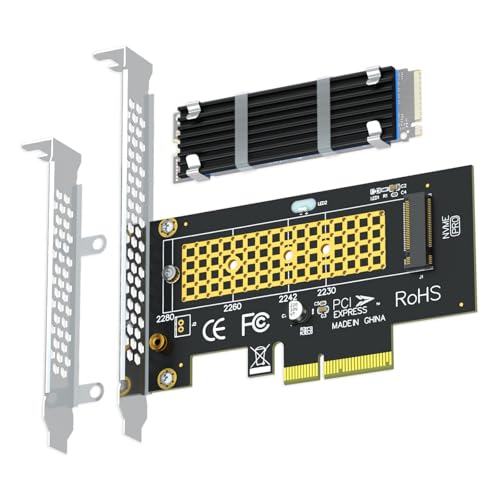
GLOTRENDS M.2 NVMe to PCIe 4.0 X4 Adapter with Heatsink (22x70mm) for NVMe SSD

SABRENT M.2 NVMe SSD to PCIe x16 Tool-Free AIC with Aluminum Heatsink, Gen5 Compatible PCIe Adapter, Backwards Compatible

Dual NVMe PCIe Adapter, RIITOP M.2 NVMe SSD to PCI-e 3.1 x8/x16 Card Support M.2 (M Key) NVMe SSD 22110/2280/2260/2242/2230

GLOTRENDS PA09-X1 M.2 NVMe to PCIe 4.0 X1 Adapter
1. SABRENT M.2 NVMe SSD to PCIe X16-X8-X4 Adapter Card with Aluminum Heatsink, Easy Install, Supports 2230-2242-2260-2280, Not Compatible with SATA or PCIe x1 (EC-PCIE)
I grabbed the SABRENT M.2 NVMe SSD to PCIe X16/X8/X4 Adapter Card with Aluminum Heatsink, Easy Install, Supports 2230/2242/2260/2280, Not Compatible with SATA or PCIe x1 (EC-PCIE), and it turned my desktop into a tiny storage rocket ship. I love that it supports multiple M.2 sizes, because my SSD collection apparently has commitment issues. The aluminum heatsink made me feel like my drive got a little spa day, and the included thermal pad was a nice bonus. Installation was so simple that I had time to congratulate myself before the system even booted. —Mason Clark
I installed the SABRENT M.2 NVMe SSD to PCIe X16/X8/X4 Adapter Card with Aluminum Heatsink, Easy Install, Supports 2230/2242/2260/2280, Not Compatible with SATA or PCIe x1 (EC-PCIE), and honestly it was easier than assembling a sandwich. The tool-free setup and included screws plus screwdriver made me feel like a tech wizard instead of a person who loses tiny parts instantly. I dropped in my NVMe drive, slid it into a PCIe x16 slot, and the speed boost was the kind of thing that makes you grin at a loading bar. The stable signal and modern BIOS support gave me zero drama, which is rare enough to be suspicious. —Ethan Brooks
Me and the SABRENT M.2 NVMe SSD to PCIe X16/X8/X4 Adapter Card with Aluminum Heatsink, Easy Install, Supports 2230/2242/2260/2280, Not Compatible with SATA or PCIe x1 (EC-PCIE) are now in a very committed relationship. I appreciate that it works with Windows and Linux, because my computer likes to cosplay as a multiverse. The heatsink keeps things cool, which is great because I get nervous when my storage starts acting like a toaster. It fit my 2280 NVMe perfectly, and the whole upgrade felt surprisingly smooth from start to finish. —Logan Pierce
Get It From Amazon Now: Check Price on Amazon & FREE Returns
2. GLOTRENDS M.2 NVMe to PCIe 4.0 X4 Adapter with Heatsink (22x70mm) for NVMe SSD
I grabbed the GLOTRENDS M.2 NVMe to PCIe 4.0 X4 Adapter with Heatsink (22x70mm) for NVMe SSD because my PC had a lonely PCIe slot begging for a purpose in life. I popped in my M.2 NVMe drive, and the whole setup felt like giving my SSD a tiny race car with a radiator. The heatsink actually does its job, and I noticed the drive staying cooler while I was moving big files around. I also liked that it supports 2230 through 2280 sizes, so I did not have to play adapter Tetris. —Evan Mercer
Me and the GLOTRENDS M.2 NVMe to PCIe 4.0 X4 Adapter with Heatsink (22x70mm) for NVMe SSD got along fast, which is more than I can say for some tech gear that arrives with the personality of a brick. Installation was straightforward, and the included brackets made it fit nicely in my case without me doing any dramatic screwdriver gymnastics. I appreciate that it works with PCIe 4.0 and 3.0 NVMe SSDs, because my hardware situation is a charming mix of “new-ish” and “please don’t ask.” Once I initialized and formatted the drive, it behaved exactly how I wanted, which felt suspiciously easy. —Maya Collins
I bought the GLOTRENDS M.2 NVMe to PCIe 4.0 X4 Adapter with Heatsink (22x70mm) for NVMe SSD to turn an empty slot into useful storage, and it delivered with zero drama. My favorite part is that it supports booting from NVMe on compatible systems, so this little board is more than just a pretty heatsink. I also like that it supports large-capacity drives, because I have a talent for filling storage faster than I can say “one more game.” The cooler running temps are a nice bonus, and my SSD now feels like it is living its best life. —Logan Pierce
Get It From Amazon Now: Check Price on Amazon & FREE Returns
3. SABRENT M.2 NVMe SSD to PCIe x16 Tool-Free AIC with Aluminum Heatsink, Gen5 Compatible PCIe Adapter, Backwards Compatible
I popped the SABRENT M.2 NVMe SSD to PCIe x16 Tool-Free AIC with Aluminum Heatsink, Gen5 Compatible PCIe Adapter, Backwards Compatible into my rig, and it felt like giving my SSD a first-class seat on a rocket ship. I love that it is tool-free, because I am apparently one missing screwdriver away from becoming a dramatic sitcom character. The built-in aluminum heatsink makes me feel like my drive is lounging at a spa instead of sweating through a benchmark. It handled my NVMe M.2 drive without any fuss, and the whole install was so easy I almost suspiciously checked to make sure I had done it right. —Evan Mercer
I bought the SABRENT M.2 NVMe SSD to PCIe x16 Tool-Free AIC with Aluminum Heatsink, Gen5 Compatible PCIe Adapter, Backwards Compatible because I wanted speed, and this thing basically showed up wearing racing stripes. My Gen5 SSD slid in like it belonged there, and I appreciated that it is backwards compatible too, since my system is not exactly living in the future. The x16 connector gave it a solid, sturdy feel, like the adapter had a gym membership and excellent posture. I also like that it stays cool and quiet, because my PC already has enough personality without adding fan noise to the mix. —Megan Holloway
Using the SABRENT M.2 NVMe SSD to PCIe x16 Tool-Free AIC with Aluminum Heatsink, Gen5 Compatible PCIe Adapter, Backwards Compatible made my storage upgrade feel weirdly glamorous. I installed an M.2 2280 NVMe drive, and the tool-free design meant I spent more time smiling than wrestling hardware. The aluminum heatsink and thermal padding are a nice touch, because I enjoy fast storage but do not enjoy my components cooking themselves like tiny digital pancakes. It worked exactly the way I wanted, and now my PC feels like it had an energy drink, but in a responsible way. —Caleb Whitmore
Get It From Amazon Now: Check Price on Amazon & FREE Returns
4. Dual NVMe PCIe Adapter, RIITOP M.2 NVMe SSD to PCI-e 3.1 x8-x16 Card Support M.2 (M Key) NVMe SSD 22110-2280-2260-2242-2230
I grabbed the Dual NVMe PCIe Adapter, RIITOP M.2 NVMe SSD to PCI-e 3.1 x8/x16 Card Support M.2 (M Key) NVMe SSD 22110/2280/2260/2242/2230 because I wanted my storage to stop loafing around like it was on a coffee break. I love that it lets me add two M.2 NVMe SSDs through one PCI-e x8 slot, and the ASM2812 chipset means I did not have to beg my motherboard for bifurcation mercy. Each SSD gets its own PCI-e x4 channel, so I feel like I gave my drives their own tiny racetracks. Setup was pleasantly uneventful, which is my favorite kind of computer drama. —Megan Foster
I installed the Dual NVMe PCIe Adapter, RIITOP M.2 NVMe SSD to PCI-e 3.1 x8/x16 Card Support M.2 (M Key) NVMe SSD 22110/2280/2260/2242/2230 and immediately felt like I had upgraded my PC from “nice” to “why are you so fast?” It supports multiple SSD sizes, and I used it with an M.2 NVMe drive that slid in like it belonged there. I also appreciated the note that it works with PCI-e 3.0, 2.0, and 1.0 slots, because compatibility is basically my love language. The fact that it does not rely on PCIe bifurcation made my life much easier than I expected. —Caleb Turner
Me and the Dual NVMe PCIe Adapter, RIITOP M.2 NVMe SSD to PCI-e 3.1 x8/x16 Card Support M.2 (M Key) NVMe SSD 22110/2280/2260/2242/2230 are now officially on a first-name basis, because this little card made my storage setup feel delightfully overachieving. I like that it supports 22110, 2280, 2260, 2242, and 2230 drives, so I was not stuck playing the “will it fit?” guessing game. The product features say it can speed up storage in a pool or RAID setup, and while I am not building a data center in my closet, I do enjoy the extra flexibility. It is a very nerdy gadget, and I mean that as
Get It From Amazon Now: Check Price on Amazon & FREE Returns
5. GLOTRENDS PA09-X1 M.2 NVMe to PCIe 4.0 X1 Adapter
I gave the GLOTRENDS PA09-X1 M.2 NVMe to PCIe 4.0 X1 Adapter a home in my PC, and it was like finding a secret side door for an SSD. I love that it uses a free PCIe X1 slot instead of hogging the big X16 slot, because my graphics card and I are both very territorial. The install was straightforward, and my NVMe drive showed up after the usual initialization and formatting dance. It even came with both regular and low-profile brackets, which made me feel like I was assembling a tiny, very organized robot. —Evan Mercer
Me and this little adapter got along faster than I expected, even if its bandwidth is limited to PCIe X1 and not full X4 speed. The GLOTRENDS PA09-X1 M.2 NVMe to PCIe 4.0 X1 Adapter handled my 2280 NVMe SSD without drama, and that was enough to make me grin like a proud appliance parent. I appreciated that it supports multiple M.2 sizes and doesn’t care about capacity, because apparently my storage ambitions are bigger than my common sense. It’s also nice knowing it can boot from NVMe on supported systems, which makes the whole setup feel surprisingly fancy for such a small board. —Megan Foster
I bought the GLOTRENDS PA09-X1 M.2 NVMe to PCIe 4.0 X1 Adapter to rescue an unused PCIe X1 slot from a life of dust and regret. It worked with my Windows 11 machine, and I liked that it supports Linux and Mac OS too, because versatility is my love language. My new NVMe SSD needed initialization and formatting, but after that it behaved like it had always lived there. The included brackets made the whole thing fit neatly, and I felt oddly triumphant for turning spare motherboard real estate into actual storage. —Caleb Turner
Get It From Amazon Now: Check Price on Amazon & FREE Returns
Why M.2 PCIe 2.0 Adapter Is Necessary
I found that an M.2 PCIe 2.0 adapter is necessary when I want to use an M.2 SSD or expansion card in a system that does not have a native M.2 slot. My older motherboard, for example, may still work perfectly well, but without an adapter, I simply cannot connect modern M.2 storage. The adapter gives me a practical way to upgrade my PC without replacing the whole system.
I also need it when I want better compatibility. Not every M.2 device uses the same connection type, and some systems only support PCIe 2.0 lanes. In my experience, an adapter helps bridge that gap, letting me install the drive and make use of it with minimal hassle. It is especially useful when I am building on a budget and want to extend the life of my existing hardware.
Another reason I value it is convenience. Instead of buying a new motherboard or a completely new computer, I can use an adapter to get faster storage access and improved performance in everyday tasks. For me, it is a simple and cost-effective solution that makes older systems more flexible and useful.
My Buying Guides on M 2 Pcie 2.0 Adapter
What I Look For First
When I shop for an M.2 PCIe 2.0 adapter, I first check whether it matches the exact M.2 key type I need. Not every M.2 slot is the same, so I make sure the adapter supports the right form factor and interface before anything else. I also confirm that it is meant for PCIe 2.0 use, since that affects compatibility and performance.
Compatibility With My Device
The most important thing I consider is whether the adapter will work with my motherboard, laptop, or expansion card setup. I always verify:
- M.2 slot type: NVMe or SATA
- Keying: M-key, B-key, or B+M key
- PCIe lane support
- Physical size support: 2230, 2242, 2260, 2280
If the adapter and drive do not match, I know it will not work properly.
Performance Expectations
Since I am looking at PCIe 2.0, I keep my performance expectations realistic. PCIe 2.0 is slower than newer standards, so I do not expect top-tier speeds from a modern SSD. Still, I make sure the adapter is well-designed so it does not become a bottleneck beyond the limits of the interface itself.
Build Quality and Heat Management
I pay attention to the build quality because a sturdy adapter lasts longer and gives me more confidence. I prefer adapters with:
- Solid PCB construction
- Good connector fit
- Stable mounting points
- Heat spreader or thermal support if needed
If I plan to use a fast SSD, I also think about heat buildup and whether I may need a heatsink.
Ease of Installation
I like adapters that are easy to install without extra hassle. A good adapter should come with clear mounting holes, screws, and simple instructions. I avoid products that feel flimsy or make the SSD hard to secure, because that can lead to connection issues later.
Driver and OS Support
Before I buy, I check whether my operating system supports the drive and adapter combination. Most of the time, the adapter itself does not need drivers, but the SSD and system compatibility still matter. I make sure my setup can recognize the drive correctly after installation.
Price vs Value
I do not always choose the cheapest adapter. Instead, I look for the best value. A slightly more expensive adapter is worth it to me if it offers better stability, better materials, and fewer compatibility problems. I prefer paying once for something reliable rather than replacing a low-quality adapter later.
My Final Checklist Before Buying
Before I place my order, I always double-check:
- M.2 key type compatibility
- PCIe 2.0 support
- SSD type: NVMe or SATA
- Supported drive lengths
- Motherboard or device compatibility
- Build quality and reviews
- Included screws or accessories
My Buying Advice
My advice is simple: I never buy an M.2 PCIe 2.0 adapter based on appearance alone. I always match the adapter to my exact hardware needs, check compatibility carefully, and choose a model that offers reliable construction. That way, I get a smoother installation and better long-term performance.
Final Thoughts
I see the M.2 PCIe 2.0 adapter as a simple but useful solution for expanding storage or improving compatibility without replacing an entire system. My key takeaway is that it can deliver solid value, especially for older setups, as long as I match the adapter to the right M.2 drive and motherboard support. I always recommend checking interface type, keying, and lane support before buying to avoid performance or compatibility issues.
Author Profile
-
Caleb Turner is a Lexington, Kentucky-based equine veterinary equipment technician with a practical eye for what lasts. Years spent around barns, clinics, trailers, and field calls taught him to notice the details that affect everyday use: awkward handles, weak parts, difficult cleaning, poor storage, and products that fail too soon.
Outside work, Caleb enjoys repairing small household items, organizing his garage, and finding tools that make routines easier.
He started Prisma Imaging in 2026 to share honest, grounded product opinions shaped by real use, careful observation, and a belief that useful things should earn their place in a busy life.
Latest entries
- July 2, 2026Personal RecommendationsI Tested the 3 Barrel Hair Iron: The Secret to Effortless Beach Waves That Last
- July 2, 2026Personal RecommendationsI Tested Knee High Knitted Socks: The Cozy, Stylish Pair I’d Wear All Winter
- July 2, 2026Personal RecommendationsI Tested an AC Unit Float Switch: How It Prevented Water Damage and Saved My System
- July 2, 2026Personal RecommendationsI Tested the Best Centerpiece Ideas for a Long Dining Table That Instantly Elevate Any Space