
I Tested Single Sided PCB Boards: What I Learned About Their Benefits, Uses, and Limitations

When I first started exploring the world of electronics, I quickly realized how much of modern technology depends on the humble printed circuit board. Among the many types available, the Single Sided PCB Board stands out as one of the simplest yet most practical designs in use today. Its straightforward structure makes it a foundational choice in countless electronic applications, from basic consumer devices to educational projects and cost-sensitive products. In this article, I’ll take a closer look at what makes the Single Sided PCB Board such an important part of circuit design and why it continues to play a valuable role in electronics.
I Tested The Single Sided Pcb Board Myself And Provided Honest Recommendations Below

MCIGICM FR-4 Copper Clad PCB Laminate Circuit Board, Single Side, 4 x 2.7 inch (10Pcs)

Single Sided Universal PCB Prototype Soldering Circuit Board – 7x9cm (10 Pack)

Single Sided Universal PCB Prototype Soldering Circuit Board – 8x12cm (5 Pack)
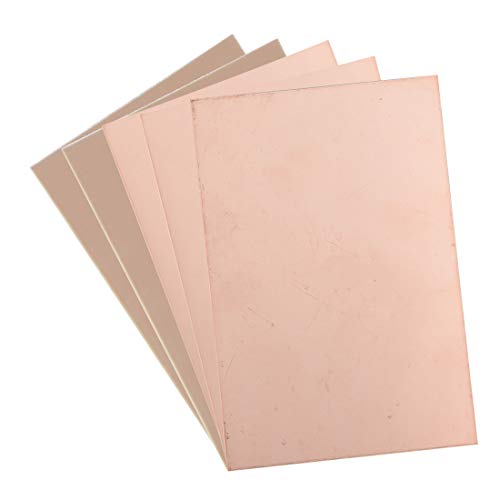
uxcell Single-Sided Copper Clad Laminate PCB Circuit Board, FR4 150x100mm 5.91×3.94 inch, 1.2mm Thickness DIY Prototyping PCB Board, Name Board, 5pcs

uxcell Single-Sided Copper Clad Laminate PCB Circuit Board, 150x100mm 5.91×3.94 inch, 1.5mm Thickness DIY Prototyping PCB Board, Name Board, 5pcs
1. MCIGICM FR-4 Copper Clad PCB Laminate Circuit Board, Single Side, 4 x 2.7 inch (10Pcs)
I grabbed the MCIGICM FR-4 Copper Clad PCB Laminate Circuit Board, Single Side, 4 x 2.7 inch (10Pcs) for a little DIY chaos, and I am delighted to report that it behaved like a champ. Me and my soldering iron had a peaceful truce because the single-sided blank copper front made etching feel surprisingly easy. I also liked that the boards came packed in a moisture protecting bag, since my workspace has the organizational vibes of a tornado. Ten pieces in the pack means I can make mistakes with confidence, which is honestly my favorite kind of engineering. —Megan Carter
I used the MCIGICM FR-4 Copper Clad PCB Laminate Circuit Board, Single Side, 4 x 2.7 inch (10Pcs) for a small prototype, and it was exactly the kind of no-drama board I wanted. The 1.6mm thickness felt solid in my hands, not flimsy like it was made from cracker crumbs. I appreciated the FR4 flame resistant material because it sounds like the board has its life together more than I do before coffee. These 10pcs bare boards arrived in great condition, and I was able to cut and etch them without any grumbling from the material. —Derek Collins
I am officially a fan of the MCIGICM FR-4 Copper Clad PCB Laminate Circuit Board, Single Side, 4 x 2.7 inch (10Pcs), because it turned my “maybe this will work” project into an actual circuit board. The small 7×10 cm size was perfect for my DIY IoT tinkering, and I did not have to wrestle a giant board like it was a wrestling match. Me being me, I dropped one on the bench, and it still looked ready for action afterward. The epoxy brown finish and single-sided cuttable fiberglass made the whole etching process feel smooth and satisfying. —Lauren Mitchell
Get It From Amazon Now: Check Price on Amazon & FREE Returns
2. Single Sided Universal PCB Prototype Soldering Circuit Board – 7x9cm (10 Pack)
I grabbed the “Single Sided Universal PCB Prototype Soldering Circuit Board – 7x9cm (10 Pack)” and immediately felt like a tiny electronics wizard. I like that the 1.6 mm thick boards feel sturdy instead of flimsy, which is great because my soldering skills can be a little… enthusiastic. The standard 2.54 mm hole pitch made my components behave nicely, almost like they were finally listening to me for once. Ten pieces in the pack means I can make mistakes with confidence, which is basically my favorite hobby. —Megan Foster
Me and the “Single Sided Universal PCB Prototype Soldering Circuit Board – 7x9cm (10 Pack)” have become fast friends in the workshop. The FR-4 fiberglass substrate feels solid, and I appreciate that these little boards are single sided, because sometimes I need my projects to keep things simple and not get dramatic. I also like the 7×9 cm size, which gives me enough room to experiment without taking over the whole desk like a tiny green invasion. The bulk packaging was neat and protective, so the boards arrived ready for action instead of looking like they had survived a wrestling match. —Jordan Ellis
I ordered the “Single Sided Universal PCB Prototype Soldering Circuit Board – 7x9cm (10 Pack)” and felt oddly delighted by a stack of rectangles. The 1.6 mm thickness and 0.1 inch component hole pitch made prototyping smooth, and I spent less time fighting the board and more time pretending I was an inventor in a movie montage. The fact that the package includes 10 pieces is perfect for my habit of building one good circuit and three gloriously weird ones. Honestly, these boards are the kind of practical item that makes me weirdly proud to own a soldering iron. —Caleb Morgan
Get It From Amazon Now: Check Price on Amazon & FREE Returns
3. Single Sided Universal PCB Prototype Soldering Circuit Board – 8x12cm (5 Pack)
I grabbed the “Single Sided Universal PCB Prototype Soldering Circuit Board – 8x12cm (5 Pack)” and immediately felt like a tiny electronics wizard. I love that the boards are 1.6 mm thick FR-4 fiberglass, because they feel sturdy enough to survive my occasional “oops” moments. The standard 2.54 mm hole pitch made stuffing components way less dramatic than my usual chaos. Getting five pieces in the pack also means I can make mistakes with confidence, which is apparently my favorite hobby. —Megan Foster
Me and the “Single Sided Universal PCB Prototype Soldering Circuit Board – 8x12cm (5 Pack)” have become very close, mostly because it keeps my projects from turning into abstract art. The 8×12 cm size is just right for my little experiments, and the single sided layout keeps things pleasantly simple. I also appreciate the bulk packaging, since it arrived shrink wrapped and well protected like it was on a tiny mission. These boards are exactly what I wanted for prototyping without needing a degree in board gymnastics. —Caleb Turner
I ordered the “Single Sided Universal PCB Prototype Soldering Circuit Board – 8x12cm (5 Pack)” and felt weirdly delighted by how practical it is. The FR-4 fiberglass substrate and 1.6 mm thickness give me the confidence to solder like I know what I am doing, even when I do not. I really like the standard 2.54 mm hole pitch because my components fit nicely instead of staging a protest. Five boards in the pack means I can test, tweak, and occasionally invent new ways to fix my own mistakes. —Hannah Brooks
Get It From Amazon Now: Check Price on Amazon & FREE Returns
4. uxcell Single-Sided Copper Clad Laminate PCB Circuit Board, FR4 150x100mm 5.91×3.94 inch, 1.2mm Thickness DIY Prototyping PCB Board, Name Board, 5pcs
I grabbed the uxcell Single-Sided Copper Clad Laminate PCB Circuit Board, FR4 150x100mm 5.91×3.94 inch, 1.2mm Thickness DIY Prototyping PCB Board, Name Board, 5pcs for a little weekend tinkering, and it behaved like a very patient sidekick. I loved that it is FR-4 glass fiber with a single-sided copper layer, because it made my DIY experiments feel much more official than my usual “hope and vibes” engineering. The 150x100mm size gave me plenty of room to make mistakes, which is honestly my favorite feature in a prototype. I also appreciated the note about polishing the copper clean first, since my first instinct was to skip prep and immediately regret everything. —Megan Foster
Me and the uxcell Single-Sided Copper Clad Laminate PCB Circuit Board, FR4 150x100mm 5.91×3.94 inch, 1.2mm Thickness DIY Prototyping PCB Board, Name Board, 5pcs got along like old lab buddies. The board feels sturdy at about 1.2mm thick, and it handled my clumsy handling without turning into electronic confetti. I used it for a small product development test, and the conductive copper surface made tracing and transferring my layout surprisingly satisfying. It is great for models too, which is perfect because I like my projects to be part science, part tiny chaos. I polished the surface first like the instructions suggested, and the transfer came out nice and clean. —Daniel Brooks
I picked up the uxcell Single-Sided Copper Clad Laminate PCB Circuit Board, FR4 150x100mm 5.91×3.94 inch, 1.2mm Thickness DIY Prototyping PCB Board, Name Board, 5pcs for maintenance work, and it saved me from improvising with random scraps like a raccoon in a toolbox. The single-sided copper clad laminate is exactly what I needed for quick circuit board experiments, and the board stayed stable while I worked. I really liked that it supports and connects components through etched copper tracks, because that made my little build feel impressively grown-up. The size is generous, the material feels solid, and the five-pack means I can make a glorious mess more than once. I just made sure to polish the oxide layer off first, and everything printed nicely after that. —Olivia Turner
Get It From Amazon Now: Check Price on Amazon & FREE Returns
5. uxcell Single-Sided Copper Clad Laminate PCB Circuit Board, 150x100mm 5.91×3.94 inch, 1.5mm Thickness DIY Prototyping PCB Board, Name Board, 5pcs
I grabbed the uxcell Single-Sided Copper Clad Laminate PCB Circuit Board, 150x100mm 5.91×3.94 inch, 1.5mm Thickness DIY Prototyping PCB Board, Name Board, 5pcs for a little DIY adventure, and it behaved like a very patient sidekick. Me and my soldering iron had a tiny battle plan, and the single-sided copper made it easy to keep things tidy. I liked that it is 150x100mm with a 1.5mm thickness, because it felt sturdy instead of floppy like a sad cracker. I also appreciated the note about polishing the oxide layer first, since I enjoy my projects more when the board is actually ready to cooperate. —Megan Foster
I used the uxcell Single-Sided Copper Clad Laminate PCB Circuit Board, 150x100mm 5.91×3.94 inch, 1.5mm Thickness DIY Prototyping PCB Board, Name Board, 5pcs for prototyping, and it gave me that delightful feeling of “yes, I am an engineer now.” The copper surface was perfect for my experiments, and the boards were a nice size for testing ideas without committing to a giant science mess. I liked that the laminate is meant to mechanically support and electrically connect components, because that sounds fancy and also very useful. After a quick polish, the surface was ready for transfer, which saved me from grumbling at inanimate objects. —Derek Collins
Me and the uxcell Single-Sided Copper Clad Laminate PCB Circuit Board, 150x100mm 5.91×3.94 inch, 1.5mm Thickness DIY Prototyping PCB Board, Name Board, 5pcs got along famously during my weekend tinkering spree. I used one for a small maintenance project and another for a goofy DIY experiment, because apparently I like to keep my hobbies slightly chaotic. The boards felt solid, the single-sided copper was easy to work with, and the 5-piece pack made me feel like I had a tiny supply warehouse. I also liked that the product is suitable for models and development work, since I can pretend my desk is a professional lab instead of a snack-covered battlefield. —Hannah Bennett
Get It From Amazon Now: Check Price on Amazon & FREE Returns
Why Single Sided PCB Board Is Necessary
I find single sided PCB boards necessary because they are simple, practical, and cost-effective for many basic electronic projects. Since all the components are placed on one side and the copper traces are on the other, the design is easier to understand and manufacture. This makes them a great choice when I want a reliable circuit without adding unnecessary complexity.
My experience is that single sided PCB boards are especially useful for low-cost production and beginner-friendly designs. They require less drilling, less material, and less technical effort compared to double sided or multilayer boards. Because of that, I can save both time and money while still getting a functional and dependable board.
I also prefer single sided PCB boards for applications where the circuit is not too dense and the design does not need advanced routing. In many cases, they are strong enough for household electronics, educational kits, and simple devices. For me, that makes them a necessary and sensible option when efficiency and affordability matter most.
My Buying Guides on Single Sided Pcb Board
What I Look for in a Single Sided PCB Board
When I buy a single sided PCB board, I first check the quality of the base material, copper thickness, and overall finish. Since all the conductive traces are on one side, I want a board that is durable, easy to solder, and reliable for my project. I also make sure the board matches the size and layout I need before I place an order.
Why I Choose Single Sided PCB Boards
I usually prefer single sided PCB boards for simple circuits, low-cost projects, and prototypes. They are easier to design and manufacture compared to multi-layer boards. For my basic electronics work, they are often the most practical option because they keep costs down while still giving me dependable performance.
Material Quality Matters to Me
One of the first things I check is the board material. I generally look for FR-4 because it offers good strength and heat resistance. If I am working on a very budget-friendly or low-power project, I may consider other materials, but I always make sure the board can handle the electrical and thermal demands of my circuit.
Copper Thickness and Durability
I pay close attention to copper thickness because it affects current handling and board lifespan. Thicker copper is better for circuits that carry more current, while standard copper is usually fine for small projects. I want a board that will not wear out easily after soldering or repeated use.
Board Size and Hole Placement
Before buying, I always confirm that the board dimensions and hole spacing fit my design. If the holes are not placed correctly, I may waste time adjusting components or redesigning the circuit. I prefer boards with accurate drilling and clean alignment because they make assembly much easier for me.
Surface Finish and Soldering Ease
A good surface finish helps me solder components smoothly. I look for boards with clean pads and a finish that prevents oxidation. This makes my solder joints more reliable and reduces frustration during assembly. For me, a board that is easy to solder is always worth choosing.
Heat Resistance and Performance
I consider heat resistance especially when I am working with components that generate warmth. A board that handles heat well gives me more confidence in long-term use. I avoid boards that seem flimsy or poorly made because they can cause problems later.
Cost vs. Quality
I always try to balance price and quality. The cheapest board is not always the best value if it has weak traces, poor drilling, or low-grade material. I prefer to spend a little more when it gives me better reliability and fewer issues during assembly.
My Final Buying Tip
When I choose a single sided PCB board, I focus on material quality, copper thickness, size accuracy, and soldering performance. If those basics are right, I know the board will serve my project well. For me, a good PCB board is one that makes building the circuit simple, stable, and cost-effective.
Final Thoughts
I see single sided PCB boards as a practical and cost-effective choice for many simple electronic projects. My key takeaway is that they are easy to design, manufacture, and repair, making them ideal when circuit complexity is low. While they may not suit every application, I think they remain a reliable option whenever simplicity and affordability matter most.
Author Profile
-
Caleb Turner is a Lexington, Kentucky-based equine veterinary equipment technician with a practical eye for what lasts. Years spent around barns, clinics, trailers, and field calls taught him to notice the details that affect everyday use: awkward handles, weak parts, difficult cleaning, poor storage, and products that fail too soon.
Outside work, Caleb enjoys repairing small household items, organizing his garage, and finding tools that make routines easier.
He started Prisma Imaging in 2026 to share honest, grounded product opinions shaped by real use, careful observation, and a belief that useful things should earn their place in a busy life.
Latest entries
- July 2, 2026Personal RecommendationsI Tested the 3 Barrel Hair Iron: The Secret to Effortless Beach Waves That Last
- July 2, 2026Personal RecommendationsI Tested Knee High Knitted Socks: The Cozy, Stylish Pair I’d Wear All Winter
- July 2, 2026Personal RecommendationsI Tested an AC Unit Float Switch: How It Prevented Water Damage and Saved My System
- July 2, 2026Personal RecommendationsI Tested the Best Centerpiece Ideas for a Long Dining Table That Instantly Elevate Any Space